Preserving Historical Icons:Hagia Sophia VR
To make one of the world's most significant cultural landmarks accessible to those who can't visit in person, Capitol Interactive partnered with Turkish agency VRTU to create an educational VR experience of Istanbul's Hagia Sophia — a structure built in 537 A.D.
Industry: Cultural Heritage & Education
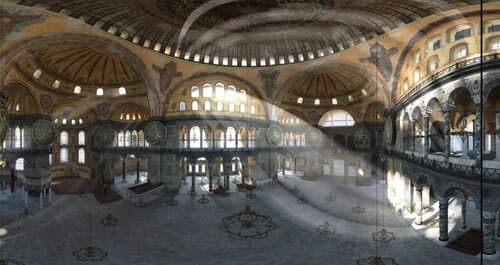
historic landmark preserved and made globally accessible through VR
A Digital Twin for a Historic Icon
Hagia Sophia, an iconic place of worship and museum constructed in 537 A.D., is one of the world's most significant cultural and historical landmarks. Located in Istanbul, Turkey, it remains inaccessible to many who find the trip financially prohibitive or who are unable to enter the country. Capitol Interactive partnered with VRTU, a Turkish interactive agency, to immortalize Hagia Sophia using virtual reality.
Our Approach
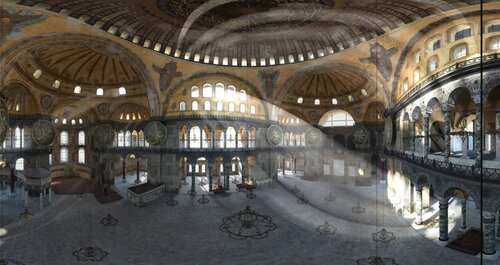
Working with Digital History Studios, we created an educational VR experience that faithfully recreated Hagia Sophia's interiors for GearVR and Google Cardboard platforms, with full support for both English and Turkish languages.
Faithful Digital Recreation
The VR experience was built to faithfully capture the architectural grandeur and historical significance of Hagia Sophia, enabling virtual visitors to explore the space as if they were standing inside it.
Multi-Language Support
With support for both English and Turkish, the experience was designed to serve both international audiences and local Turkish communities, broadening its educational impact.
Accessible Hardware Targets
By targeting GearVR and Google Cardboard — affordable, widely available VR platforms — the experience maximized accessibility for classrooms, tourism centers, and individual users worldwide.
The Results
The experience has been viewed by thousands in classrooms, tourism centers, and cultural institutions.
Hagia Sophia became accessible to global audiences who would otherwise never visit the landmark in person.
The project demonstrated VR's potential as a tool for cultural preservation and heritage education.
Preserving Heritage Through Technology
By creating a faithful digital twin of one of the world's most important historical structures, Capitol Interactive and VRTU demonstrated that virtual reality can serve as a powerful tool for cultural preservation — making priceless heritage accessible to anyone, anywhere.